Do resellers owe sales tax on cash and local sales?
Marketplaces collect sales tax for you. Cash, Venmo and craft-fair sales don’t. Who owes what, the permit you may need and how to work out the tax.
 Scott DavisFounder, MagicListr
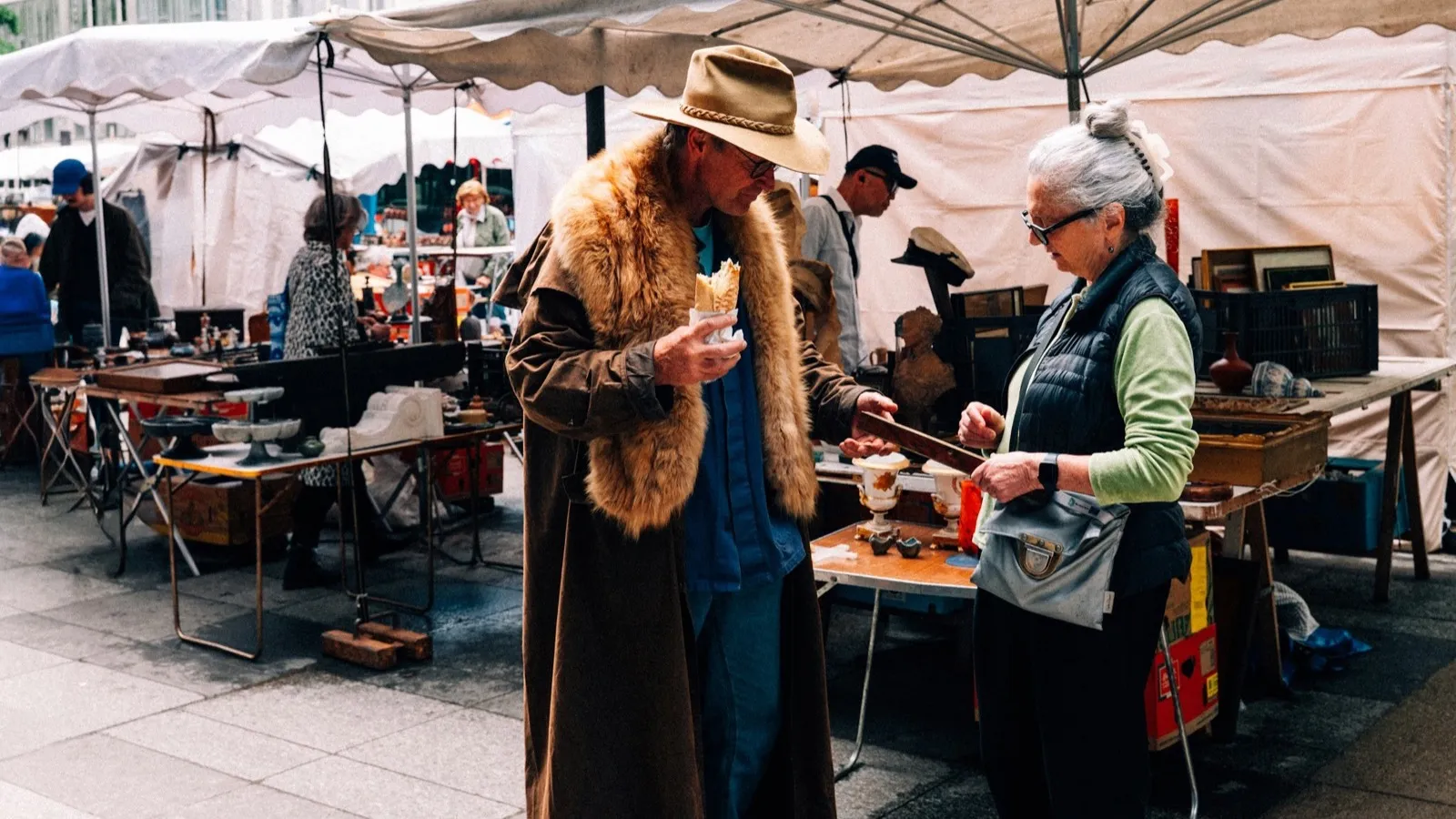
Usually, yes. When a buyer pays through a marketplace’s checkout (eBay, Poshmark, Mercari, Depop, Etsy, Vinted, Whatnot), the marketplace collects the sales tax and pays it to the state for you. When a buyer pays you directly, in cash or Venmo at a flea market, a craft fair or a porch pickup, the tax is yours. In most states that means you need a seller’s permit and owe tax at the rate where the sale happened, whether or not you charged the buyer for it.
Before MagicListr, I spent years designing financial software, most recently at BILL.com, which helps small businesses pay bills and get paid. Sales tax is one of those things that’s simple once it’s laid out, so here it is, with each marketplace’s and state’s own rules linked. It isn’t tax advice: for your situation, check your state’s revenue department or a tax professional.
Who handles sales tax, sale by sale
| Where the buyer paid | Who collects and pays the sales tax |
|---|---|
| eBay, Poshmark, Mercari, Depop, Etsy, Vinted or Whatnot checkout | The marketplace |
| Facebook Marketplace checkout, shipped | Facebook, in states that require it |
| Facebook Marketplace local pickup, paid in person | You |
| Your own Shopify store | You (Shopify calculates it, but doesn’t pay it for you unless your sales tax is managed by Shopify or you use Shopify Tax’s automated filing) |
| Cash, Venmo, PayPal or a card reader at a flea market, fair, pop-up or pickup | You |
Marketplace sales: the marketplace pays it
Every state with a sales tax now has a marketplace facilitator law, which makes the marketplace, not you, responsible for collecting and paying tax on sales through its checkout. In the marketplaces’ own words:
- eBay: “As a marketplace facilitator, eBay collects and remits taxes when required” (eBay). Its list covers every state with a sales tax, plus DC.
- Mercari, Etsy, Depop, Poshmark, Vinted and Whatnot say the same on their own help pages: Mercari, Etsy, Depop, Poshmark, Vinted, Whatnot.
- Facebook Marketplace is the one to watch. It collects on shipped checkout orders, but its help page is plain about the rest: “we don’t handle taxes for local pickup” (Facebook).
- Shopify is your own store, not a marketplace: “Shopify doesn’t remit sales tax for you, unless your US sales tax is managed by Shopify or your store is already enrolled in automated filing with Shopify Tax” (Shopify).
The tax the marketplace collects isn’t taken out of your earnings. The buyer pays it on top, and it goes straight to the state.
Do you still need a permit if you only sell on marketplaces?
It depends on your state:
- California: no, if every sale goes through a registered marketplace. You’re “not required to register with CDTFA for a seller’s permit” (CDTFA Pub 109).
- Texas: yes. A Texas seller “must have an active sales and use tax permit,” and reports marketplace sales as non-taxable on the return (Texas Comptroller).
- Washington: you don’t collect on marketplace sales, but you still report and pay its business and occupation (B&O) tax on them (Washington DOR).
So check your own state’s page, even if you never sell in person.
Cash and local sales: the tax is yours
Once a buyer hands you cash or sends you money directly, no marketplace is involved, and the sale is yours to report. California puts it this way: you have a duty to report and pay “whether or not you collect tax reimbursement from your customers” (CDTFA). If you didn’t add tax at the table, it comes out of what you took in.
What about “occasional sale” exemptions?
Most states don’t tax a true one-off, like clearing out your own closet. The exemptions are narrow, though, and stop once you’re selling regularly:
- California treats you as an occasional seller only if you make no more than two sales in 12 months, and garage sales no more than twice a year (CDTFA Pub 107, temporary sellers).
- Texas exempts selling one or two taxable items in 12 months, or up to $3,000 a year of things you bought for your own use. It doesn’t apply at a flea market or craft show that charges a booth fee (Texas Pub 96-211).
- New York wants a regular Certificate of Authority “even if your sales are only on an isolated or occasional basis” (NY Tax).
If you buy things to resell, these almost never cover you.
Craft fairs and flea markets: the rate is where you sell
For a sale in person, the tax follows the place where the buyer takes the item. Under the Streamlined Sales Tax rules many states use, “the sale is sourced to that business location” (SSUTA §310). At a fair, that’s the fair’s city and state, not your home.
Selling at an event in another state usually means registering there too:
- Washington offers a temporary registration if you do no more than two events a year there, and can fine the promoter $100 for each unregistered vendor (Washington DOR).
- California treats anyone selling at a location for less than 90 days as a temporary seller, with a temporary permit (CDTFA).
- Texas holds the market’s promoter liable for tax on sales by sellers without a permit. (Texas Pub 96-211).
A good first step is to ask the organizer, who often knows what the state expects from vendors.
What rate to use
Your rate is usually the state’s plus your city’s and county’s. The local share matters: Texas’s state rate is 6.25%, but with local taxes the average is 8.20%. Across the US the average combined rate is 7.53%, and Louisiana’s is the highest at 10.13%. Alaska, Delaware, Montana, New Hampshire and Oregon have no statewide sales tax, though some Alaska towns charge their own (Tax Foundation, midyear 2026). Most state revenue departments have a rate lookup by address.
Adding tax on top, or including it in your price
Say you sell a $40 jacket for cash, at an 8.25% rate:
| On a $40 cash sale | Tax on top | Tax included in the $40 |
|---|---|---|
| Buyer pays | $43.30 | $40.00 |
| Sales tax you owe | $3.30 | $3.05 |
| You keep | $40.00 | $36.95 |
Round cash prices are easier at a busy table, so plenty of sellers include the tax. Just price with it in mind, because you owe it either way. Some states have rules about showing tax-included prices, so check yours.
Buying inventory without paying sales tax
Once you hold a seller’s permit, you can often give a resale certificate to suppliers and skip sales tax on inventory you’ll resell. ShopGoodwill.com accepts them, with a certificate dated in the current year (ShopGoodwill). Goodwill and thrift stores in person are run locally, so ask at the register.
Sales tax isn’t income tax
They’re separate. Sales tax is the buyer’s money that you or the marketplace pass to the state. Income tax is on your profit. Marketplaces send you a Form 1099-K once you pass the federal threshold, when your payments for the year exceed $20,000 and “the number of transactions exceeds 200” (IRS), and the IRS notes you may get one below it (IRS). Some states set lower thresholds.
How MagicListr keeps track
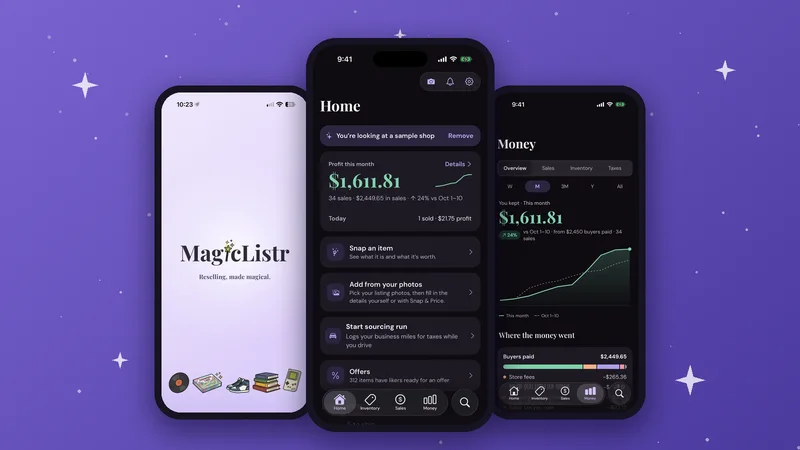
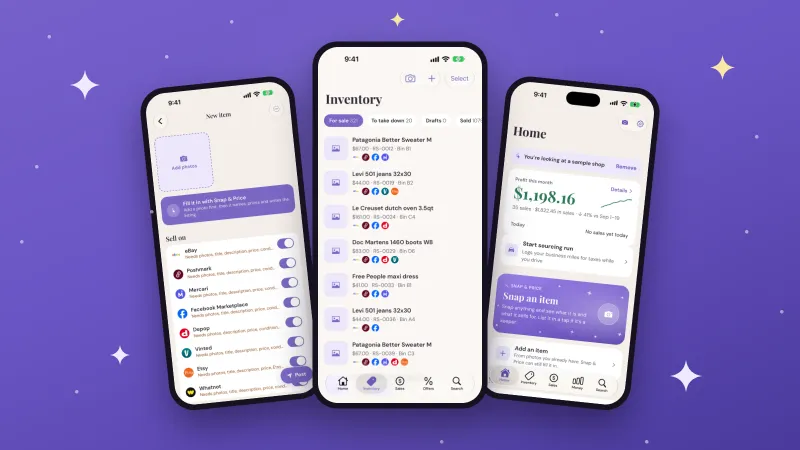
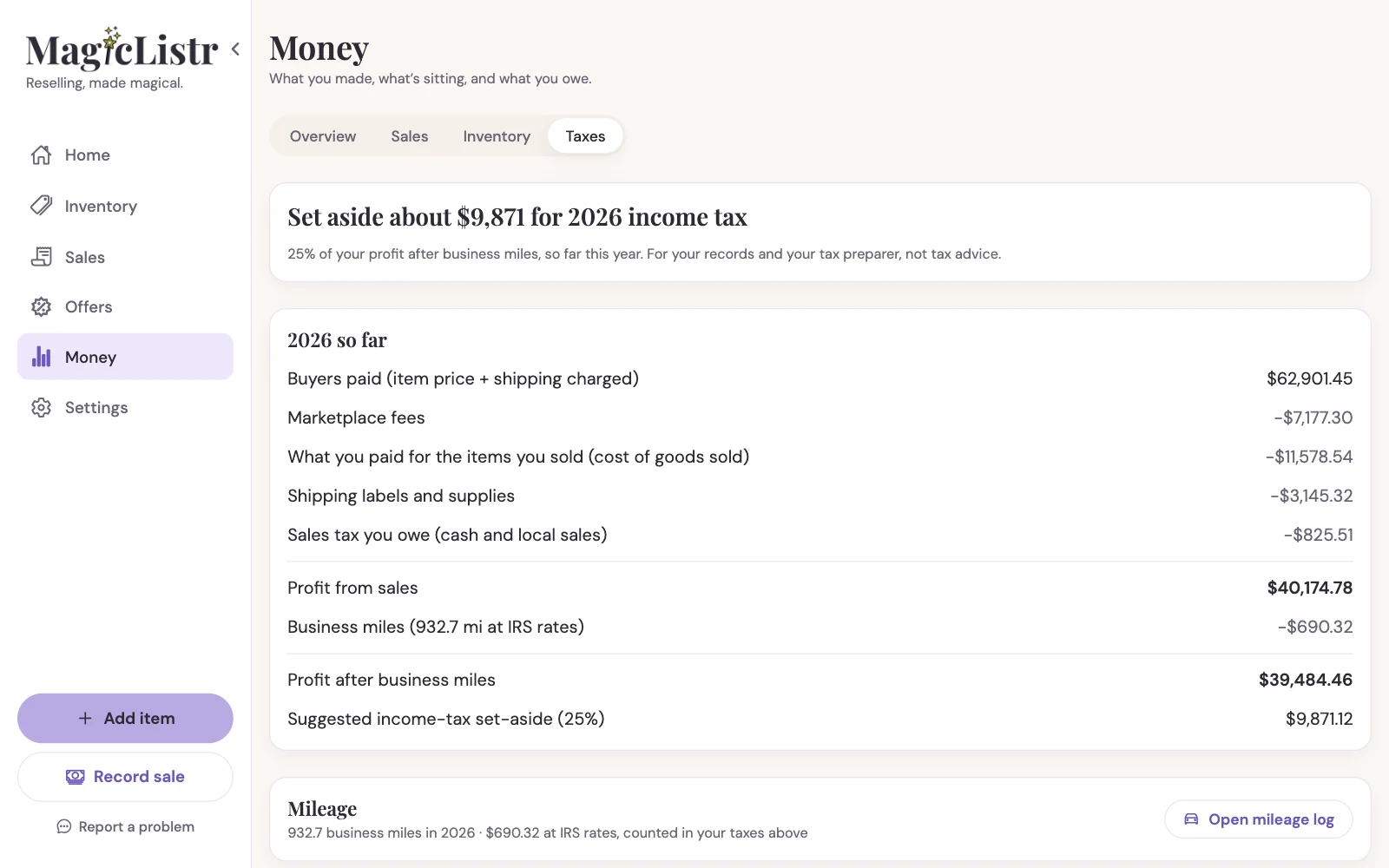
When you record a sale in MagicListr, you say how the buyer paid. If it went through a marketplace’s checkout, MagicListr knows the marketplace handled the tax. If it was cash, Venmo or another direct payment, it works out the sales tax you owe at your rate, whether your prices include tax or not, and adds it up for the year under Money → Taxes, next to your income-tax set-aside and each store’s 1099-K total.
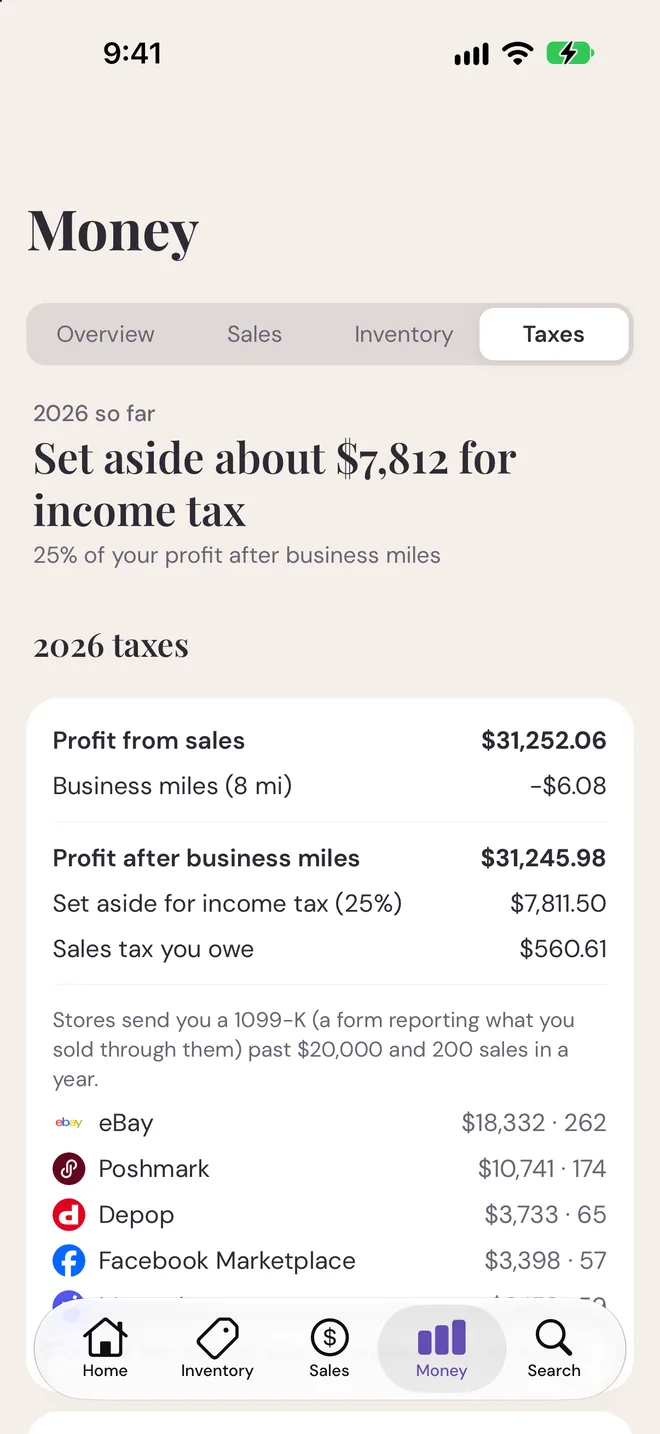

Your rate starts at your state’s own rate, and you add your city or county’s share in Settings.

What isn’t clear
Rules differ a lot by state, and local rates can change from one street to the next, so your state’s revenue department is the final word. Marketplaces update their tax help pages from time to time, and Poshmark’s link is its own seller guide from 2019. And the rates here are from mid-2026; states change them, usually in January and July.